How Augmented Reality Is Transforming Education and Learning
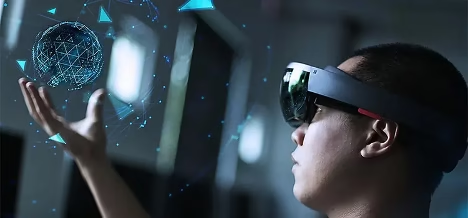
Education is changing rapidly as new technologies reshape how students learn and teachers teach. One of the most impactful innovations in recent years is augmented reality. This technology blends digital content with the real world, allowing learners to see and interact with virtual elements in their physical environment. In education, this creates more engaging, interactive, and meaningful learning experiences. From classrooms to online learning platforms, augmented reality is helping students understand complex topics more easily and stay motivated throughout their learning journey.
Understanding Augmented Reality in Education
Augmented reality is a technology that overlays digital information such as images, videos, or 3D models onto the real world using devices like smartphones, tablets, or AR glasses. In an educational setting, this means students can point a device at a book, object, or classroom space and instantly see additional learning content. Unlike virtual reality, which creates a fully digital environment, augmented reality enhances the real world instead of replacing it. This makes it more accessible and easier to integrate into everyday learning.
Making Learning More Interactive and Engaging
One of the biggest benefits of augmented reality in education is increased student engagement. Traditional teaching methods often rely on textbooks and lectures, which may not capture every learner’s attention. Augmented reality turns lessons into interactive experiences where students actively participate instead of passively listening. For example, students can explore a 3D model of the solar system, examine human anatomy in detail, or watch historical events unfold in front of them. This level of interaction makes learning more enjoyable and helps students stay focused.
Improving Understanding of Complex Concepts
Some subjects, such as science, mathematics, and engineering, involve abstract concepts that can be difficult to understand through text alone. Augmented reality helps bridge this gap by visualizing ideas in a clear and practical way. Students can see how molecules bond, how machines work internally, or how geometric shapes behave in real space. By seeing concepts rather than just reading about them, learners gain a deeper understanding and are more likely to remember what they have learned.
Supporting Different Learning Styles
Every student learns differently, and augmented reality supports a wide range of learning styles. Visual learners benefit from 3D images and animations, while kinesthetic learners enjoy interacting with virtual objects. Auditory learners can also gain value when AR experiences include sound explanations or guided narration. This flexibility allows teachers to reach more students effectively and create inclusive learning environments where everyone has a chance to succeed.
Enhancing Remote and Distance Learning
With the growth of online education, keeping students engaged outside the classroom has become a challenge. Augmented reality helps solve this problem by bringing interactive experiences into remote learning. Students can conduct virtual experiments, explore virtual classrooms, or interact with digital learning materials from home. This makes distance learning more immersive and reduces the gap between in-person and online education.
Empowering Teachers and Educators
Augmented reality is not only beneficial for students but also for teachers. It provides educators with powerful tools to explain topics more clearly and creatively. Teachers can use AR applications to demonstrate lessons, create interactive assignments, and assess student understanding in new ways. Additionally, augmented reality saves time by simplifying explanations and reducing the need for physical materials, especially for complex demonstrations.
Preparing Students for the Future
As technology continues to shape the modern workplace, students need digital skills to succeed in their careers. Exposure to augmented reality in education helps students become comfortable with advanced technologies from an early age. This prepares them for future roles in fields such as healthcare, engineering, design, and technology, where AR is increasingly being used. Learning with augmented reality builds problem-solving skills, creativity, and adaptability, which are essential in today’s world.
Conclusion
Augmented reality is transforming education by making learning more interactive, engaging, and effective. It helps students understand complex topics, supports different learning styles, and enhances both classroom and remote education. For teachers, it offers innovative ways to deliver lessons and connect with students. As technology continues to evolve, augmented reality will play an even greater role in shaping the future of education. By embracing this powerful tool, educational institutions can create richer learning experiences and better prepare students for the challenges of tomorrow.